Gudule
The Hunchback of Notre DameGudule is the bereaved mother who recognizes Esmeralda as the child taken from her fifteen years earlier. In the final movement of their story, a little shoe turns an encounter between captor and captive into a reunion, but not a rescue: Gudule’s attempt to shield her daughter from the authorities ends in her death.
Identity and Loss
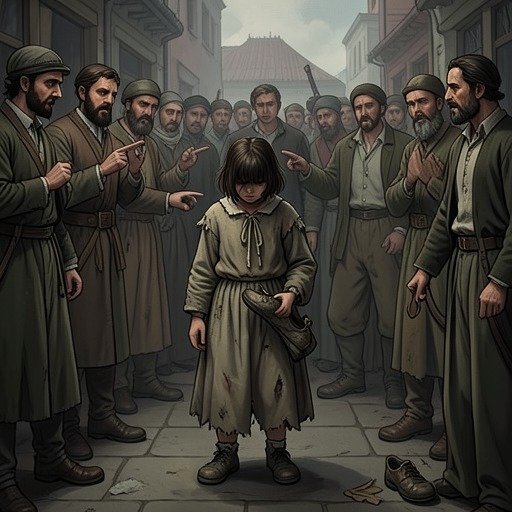
Gudule lives confined in a cell at the Rat-Hole. She identifies her former life with Reims and the name Paquette la Chantefleurie, and recalls having been a poor woman of the town. Her daughter, Agnes, was taken from her when the child was small. Gudule believes the Bohemians stole the girl and left her mother to think her dead; she says she kept a shoe from the child for fifteen years. The long interval has not softened the loss. It has become the defining fact of Gudule’s life in isolation.
Her account also gives the confinement a material history: she says she spent fifteen years in the cellar without a fire in winter. The little shoe is what she preserved from the child, and what she can still offer as proof. Gudule’s recollection of her earlier life and her insistence that she is not a beggar make her plea to the soldiers personal and concrete. She asks them to understand that she wants nothing for herself but the return of her daughter.
From Captor to Mother
At first, Gudule does not recognize Esmeralda. When the young woman is brought to the opening in the cell wall, Gudule holds her by the elbow and calls for vengeance, believing that the gypsy before her is connected to the loss of her child. She repeats the accusation that the gypsies took Agnes, while Esmeralda answers that she may not even have been born at the time. Their encounter begins in a painful misunderstanding: Gudule sees the supposed cause of her bereavement, while Esmeralda is herself the missing child.
The recognition depends on an object rather than an explanation. Esmeralda opens the little bag she wears around her neck and takes out a small shoe matching the one Gudule kept. A parchment attached to it bears a charm about a mother embracing her child when the pair is reunited. Seeing the second shoe, Gudule understands who stands before her. Esmeralda answers that she is Gudule’s daughter, and the two women reach through the barred opening to touch. The wall allows contact but prevents an embrace, making the reunion at once certain and physically incomplete.
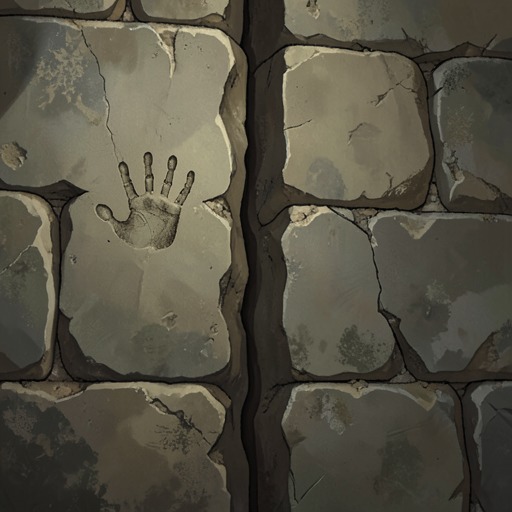
Gudule then breaks the barrier herself. She takes a heavy paving stone from the cell and uses it to smash the rusted bars across the window. Once an opening is made, she pulls Esmeralda inside and holds her as though she were still the little Agnes she had lost. Her response moves between laughter, singing, kisses, and tears. This sudden change in action is also a change in identity: the woman who seized Esmeralda as an enemy becomes a mother trying to recover the years in which they were separated.
The Attempt to Protect Esmeralda
The reunion is interrupted when Gudule hears soldiers approaching. At first she urges Esmeralda to flee, recognizing that the search has reached the Rat-Hole and that her daughter remains in danger. She then tells her to stay quiet because soldiers are everywhere and it is too light to escape. The warning marks how little control Gudule has over the situation: she can break the cell’s bars, but she cannot make the surrounding pursuit disappear.
When Tristan l’Hermite and the sergeants arrive, Gudule tells them that Esmeralda is her daughter. She recounts the stolen child, the fifteen years of separation, and the shoe she kept. She appeals to their past acquaintance, to their capacity for pity, and to the claim that a mother and daughter should be allowed to leave together. She also insists that Esmeralda has done nothing to them and says that the king’s authority does not make the young woman his possession. Her plea is not a general request for leniency: she offers the matching shoe and her own history as reasons the soldiers should recognize the relationship and let them go.
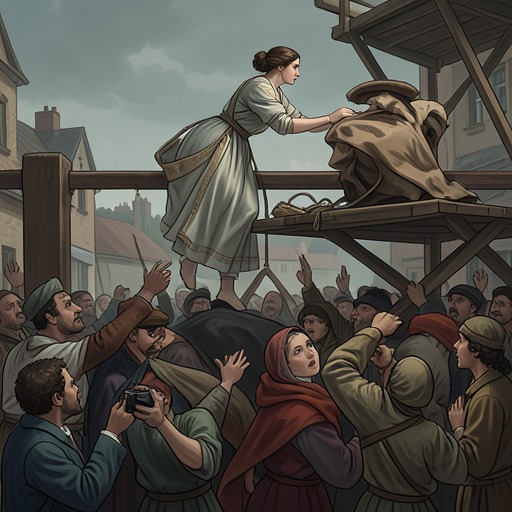
The soldiers do not release Esmeralda. When the executioner enters, Gudule makes no attempt to resist by force at first; she throws herself over her daughter and holds her close. As the condemned young woman is taken away, Gudule clings to her so tightly that they cannot initially be separated. She tells Esmeralda that she is defending her, but her protection cannot overcome the officers’ power to carry out the sentence.
Death and Narrative Significance
At the foot of the ladder, Gudule remains crouched beside her daughter. When the executioner resumes taking Esmeralda toward the gallows, Gudule attacks his hand. The soldiers force her away; she falls and dies. The action costs her life without stopping the execution. Her final attempt is nevertheless continuous with the reunion itself: after fifteen years of being unable to protect the child she believed lost, she uses what strength she has left to oppose the force taking her daughter from her again.
Gudule’s arc turns on recognition arriving too late to change the outcome. The shoes recover the truth of Esmeralda’s birth and transform a history of accusation into a bond the two women can name and briefly share. Yet the revelation comes only as the authorities close in, so private knowledge cannot undo the public sentence. The cell’s bars first keep mother and daughter apart, then fall to Gudule’s blows, and finally give way to the soldiers’ seizure of Esmeralda. The reunion is real, but its shortness makes the recovered relationship inseparable from another separation.